 Schedule a Service

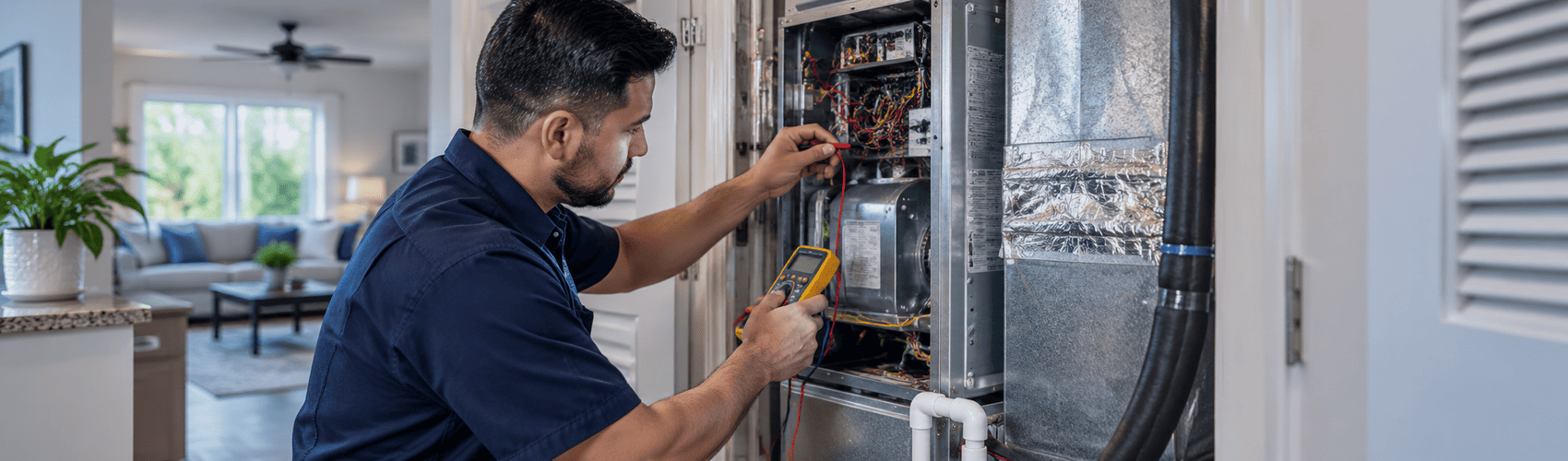
The upstairs master bedroom feels like a sauna, so the outdoor AC must be dead, right? Not necessarily. That hot room could easily stem from a leaking attic duct, a weak blower motor, or a miscalibrated thermostat that stops reading room temperatures accurately.
In this guide, we will cover why HVAC issues are rarely as simple as they look, how to spot warning signs early, and what a whole-system diagnostic involves. In a city like Richardson—where established homes feature layouts built across different decades—understanding how heating, cooling, airflow, and controls interact saves you from replacing expensive parts that were never broken.
HVAC System Diagnostic Overview
| Observed Comfort Issue | Expected Culprit | Actual Component Often Responsible |
| Upstairs Room Stays Hot | AC Condenser | Leaking flex duct, low static pressure, poor insulation |
| Furnace Shuts Off Repeatedly | Burners / Gas Line | Clogged air filter, tripped high-limit switch, bad draft |
| Neither Heat Nor AC Responds | Main Unit Mechanicals | Tripped float switch, dead 24V transformer, thermostat |
| System Cycles Every 3 Minutes | Broken Compressor | Oversized equipment, dirty coils, faulty thermostat sensor |
| Airflow Decreases Gradually | Failing Motor | Frozen evaporator coil, crushed return duct, clogged filter |
Key Takeaways
- The symptom in a living space rarely identifies the exact component that failed inside the HVAC system.
- In Richardson homes, heating and cooling equipment, ductwork, and digital controls are frequently updated at different stages of the home’s life.
- Whole-system diagnostics test electrical signals, static pressure, and thermal loads rather than swapping parts by trial and error.
- Basic checks like clearing return vents and replacing dirty filters are safe for homeowners, but high-voltage and gas controls require professional service.
What Does HVAC Repair Include?
When you request HVAC repair in Richardson, you aren’t just fixing one box outside. A modern comfort system functions as an interconnected network:
- Cooling Equipment: Testing outdoor compressors, checking refrigerant charge, clearing frozen evaporator coils, and replacing fan capacitors.
- Heating Components: Servicing gas furnace burners, cleaning flame sensors, checking hot-surface igniters, and inspecting heat exchangers.
- Airflow & Ventilation: Measuring static duct pressure, balancing dampers, clearing condensate lines, and testing blower speeds.
- Electrical & System Controls: Tracing low-voltage circuits, calibrating thermostats, and replacing faulty contactor relays.
7 Signs You Need HVAC Repair in Richardson
- System Refuses to Start: Adjusting the thermostat produces no sound, fan movement, or click from the equipment.
- Off-Temperature Air: Vents blow lukewarm air during summer cooling cycles or chilly air during winter heating cycles.
- Weak Airflow: Registers deliver noticeably less air volume, leaving rooms feeling stuffy.
- Frequent Short-Cycling: The unit runs for two minutes, shuts off abruptly, and attempts to restart moments later.
- Unusual Noises: Metallic grinding signals motor bearing failure, while rapid clicking points to control relay glitches.
- Uneven Temperatures: Certain areas maintain temperature while adjacent bedrooms stay significantly warmer or colder.
- Spiking Energy Bills: Utility bills surge without a corresponding weather change, indicating severe motor strain or duct leaks.
The Problem Isn’t Always Where You Feel It
Assuming a symptom in a specific room points directly to the nearest mechanical unit is a common mistake. HVAC systems rely on delicate balances between electrical signals, airflow pressure, and thermal transfer.
| What You Notice | What You Might Suspect | What the Diagnostic Often Finds |
| One bedroom stays hot in July | Failed AC Condenser | Disconnected attic duct or closed balancing damper |
| Furnace turns on, then dies | Broken Gas Burners | Clogged air filter causing high-limit safety shutdown |
| Neither AC nor heat responds | Total Equipment Failure | Overflowing drain pan tripping a 24V float switch |
| System runs nonstop without cooling | Low Refrigerant | Heavily caked indoor coil blocking heat transfer |
When an indoor coil freezes solid, it starves the system of air, making the blower sound strained while the compressor runs endlessly. Replacing the compressor won’t fix the issue if the real culprit was a $15 clogged air filter.
Why Richardson Homes Can Have Mixed-Age HVAC Systems
Richardson’s established neighborhoods carry deep character, with municipal records placing the median home age built around 1981 and showing that over 44% of local housing was constructed prior to 1980.
In a typical Richardson home, you will frequently find an outdoor AC condenser installed in 2021 paired with a gas furnace from 2012, operating alongside flex ductwork modified during a 1990s remodel and controlled by a smart thermostat added last year. Because these components evolve in stages across decades, a proper evaluation treats the entire setup as a single network to ensure modern equipment isn’t being choked by legacy ductwork.
What Can You Check Before Calling an HVAC Technician?
- Check Thermostat Settings: Ensure the mode is set to HEAT or COOL with the target temperature set 3 degrees beyond current room readings. Replace blank display batteries.
- Inspect the Air Filter: A filter covered in dust restricts airflow, triggering furnace lockouts and freezing cooling coils. Replace dirty filters immediately.
- Verify Vent Registers Are Clear: Confirm that rugs, drapes, or furniture aren’t blocking supply registers.
- Check the Circuit Breaker: Reset a tripped HVAC breaker once.
When DIY Troubleshooting Should Stop
Stop DIY efforts immediately if:
- A circuit breaker trips a second time after being reset once.
- You smell burning plastic, electrical arcing, or a rotten egg natural gas odor.
- Standing water pools beneath your indoor air handler or furnace.
- Your outdoor cooling unit is encased in a block of solid ice.
- You hear loud metallic grinding or screeching from the blower cabinet.
How Professional HVAC Diagnostics Work
- Symptom Review: Discussing temperature swings, unusual sounds, and recent performance changes.
- Thermostat & Control Tracing: Testing low-voltage signals, circuit board relays, and safety float switches.
- Airflow & Static Pressure Testing: Measuring static pressure across the blower and ductwork to verify air movement.
- Electrical Component Testing: Checking capacitor microfarads, contactor pitting, and motor operating amperage.
- Refrigerant & Combustion Evaluation: Checking refrigerant pressures during summer or burner flame safety during winter.
- Upfront Explanation: Presenting exact diagnostic findings and providing a flat-rate repair estimate before work begins.
HVAC Repair or System Replacement?
| Scenario / System Condition | Repair Makes Sense | Replacement Deserves Evaluation |
| Equipment Age | Under 10 years old | Over 12–15 years old |
| Repair Cost Scope | Minor component (capacitor, switch) | Major failure (compressor, heat exchanger) |
| Service History | Isolated failure after years of operation | Repeated seasonal service calls |
| Refrigerant Type | Modern R-410A or R-32 systems | Phased-out, costly R-22 Freon |
Emergency HVAC Repair in Richardson
HVAC failures don’t follow convenient schedules. An air conditioner is most likely to quit on a 100°F July weekend, and a furnace usually locks out during a sub-freezing winter snap. Emergency HVAC repair provides rapid diagnostic relief when extreme outdoor weather threatens indoor safety, electrical burning smells appear, or a system fails completely during peak seasonal demands.
Tired of Guessing Which Part of Your HVAC System Is Giving Up?
When your living room feels uncomfortable, spending hours guessing whether the problem lives in your attic ducts, your thermostat, or your outdoor unit only adds to the frustration. Give your household total peace of mind by calling the local pros who have been servicing North Texas comfort systems since 1957. Reach Harlen Johnson HVAC, Plumbing & Electrical at 972-241-7771 today—our certified technicians will run a complete whole-system diagnostic, pinpoint the exact root cause, and get your indoor air flowing crisp and clean!
Frequently Asked Questions About HVAC Repair in Richardson, TX
What does HVAC repair include?
HVAC repair includes diagnosing and fixing components across your entire heating, cooling, and ventilation network—including capacitors, compressors, gas burners, igniters, blower motors, duct connections, and digital thermostats.
Why is my HVAC running but not heating or cooling?
A system running without altering air temperature usually suffers from restricted airflow (clogged filter), low refrigerant, a failed capacitor, or a safety lockout triggered by an overheating furnace component.
Why does my HVAC keep turning on and off rapidly?
Rapid cycling (short-cycling) is commonly caused by restricted airflow, an improperly sized heating or cooling unit, a faulty thermostat sensor, or a dirty coil triggering safety shutoffs.
Can a bad thermostat cause total HVAC failure?
Yes. A faulty thermostat, dead batteries, or loose 24V control wiring can prevent start signals from reaching both your outdoor air conditioner and indoor furnace, leaving the system unresponsive.
Why is airflow weak throughout my entire house?
Weak airflow across all registers typically points to a heavily clogged return air filter, a failing indoor blower motor capacitor, a frozen evaporator coil, or crushed main ductwork in the attic.
Why is one room hotter or colder than the rest of the house?
Uneven room temperatures usually stem from leaking attic duct connections, closed supply dampers, poor insulation in that specific room, or improper duct sizing rather than a main equipment failure.
Should I repair or replace my HVAC system?
If your equipment is under 10 years old and the repair cost is reasonable, repairing it is recommended. If the system is over 12–15 years old, uses phased-out R-22 refrigerant, or requires a major component replacement, upgrading offers better long-term efficiency.
How much does HVAC repair cost in Richardson, TX?
HVAC repair costs depend on the specific component that failed and diagnostic time. Minor electrical fixes or filter clears are relatively low cost, while major component replacements carry higher part investments. Clear flat-rate quotes are provided before repairs begin.
Do you offer emergency HVAC repair in Richardson, TX?
Yes. Harlen Johnson HVAC, Plumbing & Electrical offers 24/7 emergency HVAC repair across Richardson and nearby North Texas communities for urgent situations where indoor temperatures become unsafe.