 Schedule a Service

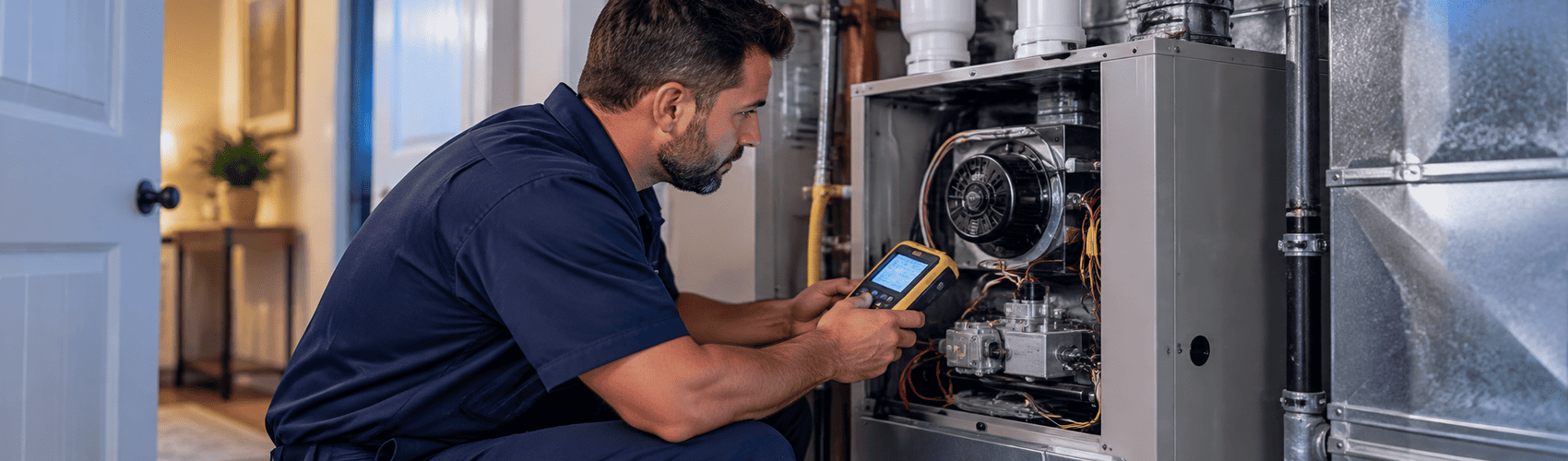
The thermostat display reads HEAT, set to a cozy 72°F. In the attic or utility closet, you hear the familiar hum of the blower fan kicking on right on schedule. Yet ten minutes later, you stand under a hallway supply register holding up a hand, only to feel a gentle stream of chilly air blowing across your knuckles.
In this guide, we will teach you why a furnace can run without delivering heat, how to spot the early warning signs of component failure, and what simple troubleshooting steps you can perform before calling a technician. In a city like Richardson—where established neighborhoods feature a median home age built around 1981—it is common to find newer heating units connected to older ductwork and legacy thermostat wiring. Knowing how these pieces work together helps you keep your home warm when North Texas winter cold snaps arrive.
Furnace Diagnostic Overview
| Observed Issue | Likely Root Cause | Diagnostic & Repair Focus |
| Blower Runs, Air Is Cold | Dirty flame sensor, failed igniter, gas valve lockout | Ignition sequence trace, sensor cleaning, gas valve test |
| Furnace Short-Cycles | Clogged air filter, overheating heat exchanger, limit trip | Airflow test, static pressure, high-limit switch review |
| Furnace Will Not Start | Tripped breaker, dead thermostat, blown transformer | Electrical circuit trace, 24V control check, safety resets |
| Weak Airflow to Vents | Dirty filter, slipping blower belt, duct leaks | Blower motor inspection, filter check, duct connection test |
| Banging or Click Noises | Delayed gas ignition, expanding metal, bad relay | Burner cleaning, gas pressure calibration, relay check |
Key Takeaways
- A furnace blowing cold air is often reacting to a safety lockout triggered by dirty sensors, igniter failure, or restricted airflow.
- In Richardson homes, newer furnaces frequently operate alongside legacy ductwork and past remodel additions, making total airflow evaluation critical.
- Basic homeowner troubleshooting includes verifying thermostat settings, replacing dirty filters, and checking circuit breakers once.
- Gas controls, electrical tracing, and internal safety bypass checks should always be left to certified HVAC professionals.
7 Signs You Need Furnace Repair in Richardson
- Your Furnace Is Blowing Cold Air: The blower fan runs continuously, but supply vents push chilly or room-temperature air.
–
- The Furnace Short-Cycles: The unit runs for ninety seconds, shuts down, and restarts three minutes later due to overheating.
- Your Furnace Will Not Start At All: Turning up the thermostat produces total silence from your heating system.
- Airflow Feels Weak Across All Rooms: Warm air comes out of the registers, but barely trickles into living spaces.
- You Hear Banging, Grinding, or Clicking: Loud popping signals delayed gas ignition, squealing indicates bad bearings, and clicking points to control board glitches.
- Some Rooms Stay Cold While Others Stay Warm: Unbalanced ductwork or leaking connections in attic spaces prevent warm air from reaching distant registers.
- The Same Issue Keeps Returning: Repeated temporary resets signal that an underlying mechanical or electrical component requires professional attention.
Why Is My Furnace Blowing Cold Air?
| Possible Cause | What You Notice | Recommended Repair Action |
| Dirty Flame Sensor | Furnace starts, ignites briefly, then shuts off | Clean or replace the oxidation on the flame rod |
| Failed Hot-Surface Igniter | Blower runs, but burners never light up | Test resistance and replace cracked igniter element |
| Clogged Air Filter | Furnace heats briefly, then trips high-limit switch | Replace air filter and reset system power |
| Faulty Gas Valve | Igniter glows, but gas does not flow to burners | Check 24V signal to valve and replace gas assembly |
| Thermostat Miscalibration | Fan runs continuously on “ON” mode instead of “AUTO” | Switch thermostat fan setting from ON to AUTO |
When a gas furnace initiates a heating cycle, it follows a strict safety sequence: the draft inducer starts, the pressure switch verifies draft, the igniter glows, the gas valve opens, and the flame sensor verifies combustion. If any single step fails, the control board cuts gas flow while keeping the blower running to purge heat—resulting in cold air blowing through your vents.
Why Does My Furnace Keep Turning On and Off?
Short-cycling occurs when internal safety controls interrupt the heating process before your home reaches set temperature.
The most common culprit is restricted airflow. When a dirty filter or blocked return register prevents cool air from drawing across the heat exchanger, internal temperatures spike rapidly. The high-limit safety switch detects this dangerous heat build-up and shuts off the gas valve to prevent the heat exchanger from cracking. Once the unit cools down slightly, the system attempts to restart, repeating the cycle endlessly.
Richardson Homes Can Have a New Furnace and Older Airflow Problems
Neighborhood records in Richardson show a median home age built around 1981, with roughly 44% of local housing constructed prior to 1980.
A Richardson home might feature a high-efficiency gas furnace installed in 2022 operating on ductwork designed during the late 1970s, controlled by a smart thermostat added last year. When a room stays cold, blaming the brand-new furnace combustion burners is often a mistake. Leaking attic duct connections, undersized return grilles from original construction, or modified room layouts frequently restrict airflow, making a perfectly good furnace look like it is underperforming.
What Can You Check Before Calling for Furnace Repair?
- Verify Thermostat Mode: Ensure the thermostat is set to HEAT (not COOL or OFF) and set at least 3 degrees above room temperature. Confirm the fan is set to AUTO.
- Inspect the Air Filter: If light cannot pass through the filter mesh, replace it immediately.
- Check Your Main Breaker Panel: Reset the circuit breaker labeled Furnace or HVAC once.
- Ensure Supply Vents Are Open: Confirm that furniture, rugs, or drapes are not blocking air registers.
Crucial Safety Warning: Never repeatedly reset a breaker that continues to trip. Never open gas valve controls or bypass safety switches. If you smell natural gas (rotten eggs), evacuate immediately and call 972-241-7771 or emergency services from a safe distance.
Furnace Repair vs. Furnace Replacement
| Decision Factors | Repair Makes Sense | Replacement Deserves Evaluation |
| Component Condition | Single isolated component failure | Cracked heat exchanger or failed main control board |
| Equipment Age | Furnace is under 12 years old | Furnace is approaching 15–20 years of service |
| Repair Frequency | First service call in several seasons | Repeated service calls during recent winter cycles |
| Operating Safety | All safety controls test within specs | Heat exchanger compromise or rust perforation present |
What Happens During a Furnace Repair Visit?
- Reviewing Operating Symptoms: Discussing when the issue started, unusual sounds, or temperature drops.
- Control & Electrical Diagnostics: Testing low-voltage wiring, thermostat signals, transformers, and safety switches.
- Ignition Sequence Inspection: Watching burner sequence to verify inducer draft, igniter resistance, and flame sensor current.
- Airflow & Blower Check: Measuring static pressure, checking blower motor capacitor microfarads, and inspecting filters.
- Upfront Quote & Execution: Explaining the failed component and providing a flat-rate estimate before executing repairs with OEM parts.
Emergency Furnace Repair in Richardson
Heating repairs become an urgent emergency when indoor safety or structural integrity is threatened:
- Zero Heat During Sub-Freezing Snaps: Temperatures dropping below freezing place your family and indoor plumbing at risk.
- Strong Burning or Electrical Odors: Pungent odors near the air handler signal overheating wire insulation or failing motor windings.
- Carbon Monoxide Alarm Activation: If your CO detector sounds, evacuate the property immediately and request an urgent heating inspection.
Common Furnace Repairs in Richardson
- Igniter Replacement: Swapping cracked hot-surface igniters that can no longer ignite gas burners.
- Flame Sensor Cleaning: Removing carbon oxidation from flame rods so the control board registers active combustion.
- Blower Motor & Capacitor Repair: Replacing weak capacitors or failing blower motors to restore airflow.
- Limit Switch Replacement: Replacing faulty temperature safety switches that trigger premature shutdowns.
Tired of Waiting for Your Vents to Produce Actual Heat?
When your furnace blower is running but your living room stays chilly, guessing which internal sensor or igniter failed only prolongs the discomfort. Give your household fast, dependable warmth by calling the local specialists who have been keeping North Texas homes cozy since 1957. Reach Harlen Johnson HVAC, Plumbing & Electrical at 972-241-7771 today—our certified technicians will diagnose your furnace failure, explain your options clearly, and get your indoor heat blowing warm and strong!
Frequently Asked Questions About Furnace Repair in Richardson, TX
Why is my furnace running but not heating?
A furnace running without producing heat is typically experiencing an ignition failure or a safety lockout caused by a dirty flame sensor, worn igniter, or restricted airflow tripping the high-limit switch.
Why is my furnace blowing cold air?
When a gas furnace detects a safety issue, it shuts off fuel flow to the burners while keeping the blower fan running to purge internal heat, resulting in cold air coming from your vents.
Why does my furnace keep turning on and off?
Rapid cycling (short-cycling) is usually caused by restricted airflow from a dirty filter or clogged return, which causes the heat exchanger to overheat and trip safety switches.
Can a dirty filter stop my furnace from heating?
Yes. A heavily clogged air filter restricts airflow, causing internal furnace temperatures to spike and triggering the high-limit switch to shut off the gas burners.
Why is one room colder than the rest of the house?
Uneven room temperatures are usually caused by leaking attic ductwork, closed supply registers, poor ceiling insulation, or unbalanced duct runs rather than a combustion failure in the furnace itself.
Should I repair or replace my aging furnace?
If your furnace is under 12 years old and requires a minor part replacement, repair is recommended. If the system is over 15 years old, requires frequent service, or has a compromised heat exchanger, replacement offers better long-term reliability.
Does Harlen Johnson provide emergency furnace repair in Richardson, TX?
Yes. Harlen Johnson HVAC, Plumbing & Electrical provides 24/7 emergency furnace repair across Richardson and nearby North Texas communities during total heating failures and cold snaps.