
 Schedule a Service


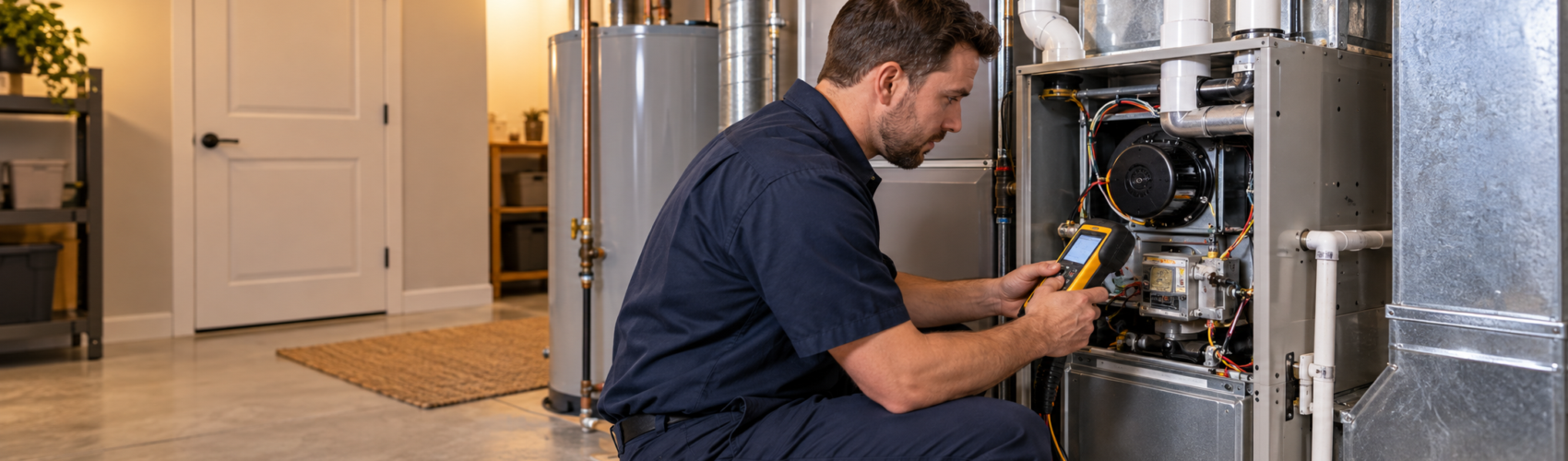
The first real cold front of the season rolls across Lake Ray Hubbard, and you finally switch the thermostat from COOL to HEAT. The furnace kicks on. You hear the fan. You wait for that familiar warm, slightly dusty smell of the first heat of the year. Instead, the air coming out of the vents feels exactly like the air in the room. The furnace is clearly running. So why is it not heating?
In this guide, we will explain how a gas furnace decides whether it is safe to make heat, why a single weak link in that process makes it blow cold air or shut down early, and what you can check before calling for furnace repair in Rowlett. Many Rowlett furnaces sit in attics, garages, or hall closets and sit unused for seven or eight months a year, then are asked to work hard overnight when a norther blows in. Knowing how the system works helps you understand what went wrong.
Furnace Not Heating Diagnostic Overview
| What You Notice | Likely Cause | What Gets Checked |
| Fan runs, air is cold | Ignition failure or safety lockout | Igniter, flame sensor, gas valve, pressure switch. |
| Heats briefly, then shuts off | Dirty flame sensor or overheating | Flame signal, filter, limit switch. |
| Turns on and off every few minutes | Short-cycling from restricted airflow | Filter, coil, returns, blower, limit switch. |
| Clicks but never lights | Igniter, gas supply, or control board | Igniter resistance, gas pressure, board signals. |
| Warm air, but not enough | Airflow or duct problems | Static pressure, ducts, blower speed. |
| Lights flash on the furnace | Control board fault code | Code lookup and component testing. |
Key Takeaways
- A gas furnace follows a strict safety sequence every time it starts. If any step fails, it shuts off the burners, often while the blower keeps running, so you feel cool air.
- Dirty flame sensors, worn igniters, clogged filters, and blocked vents are among the most common reasons a furnace runs without heating.
- Short-cycling is usually a sign of overheating from restricted airflow, not a thermostat problem.
- Homeowners can safely check the thermostat, filter, breaker, and vents. Gas valves, wiring, and safety switches should be left to professionals.
How a Gas Furnace Makes Heat, Step by Step
Understanding the sequence makes the symptoms make sense. When the thermostat calls for heat, a modern gas furnace goes through these steps:
- The draft inducer motor starts to pull air through the heat exchanger and push exhaust out the vent.
- The pressure switch confirms that the vent is clear and draft is established.
- The hot surface igniter glows or a spark igniter fires.
- The gas valve opens and the burners light.
- The flame sensor confirms that a flame is present. If it does not detect flame within seconds, the gas valve closes.
- The blower starts after the heat exchanger warms up and pushes warm air through the ducts.
- The limit switch watches the temperature and shuts down the burners if the furnace overheats.
If any of these steps fails, the control board stops the process. Depending on where it fails, the furnace may try again a few times and then lock out, or keep the blower running to cool down the heat exchanger. That is when you feel cold or lukewarm air from the vents.
6 Signs Your Furnace Needs Repair
- Cold air from the vents while the furnace is running in heat mode.
- Short cycles where the furnace runs for a minute or two, shuts off, and restarts.
- Clicking with no ignition, often several attempts in a row.
- A flashing light on the furnace control board.
- Loud booms or bangs when the burners light, which can mean delayed ignition.
- Rising gas bills with less comfort than before.
Why Is My Furnace Blowing Cold Air?
| Possible Cause | What Happens | Typical Fix |
| Dirty flame sensor | Burners light, then shut off within seconds. | Clean or replace the sensor. |
| Failed igniter | No glow, no ignition. | Replace the igniter. |
| Pressure switch problem | Inducer runs, but ignition never starts. | Clear vent or condensate blockage, test or replace switch. |
| Gas supply issue | Igniter glows, but no flame. | Check gas valve and supply pressure. |
| Thermostat fan set to ON | Fan runs constantly, even between heat cycles. | Set the fan to AUTO. |
A dirty flame sensor is one of the most common furnace problems we see after a long off-season. A thin coating forms on the sensor rod, the control board cannot read the flame, and it shuts off the gas for safety. It is a simple fix for a technician, but it is a safety device, so it should not be bypassed.
Why Does My Furnace Keep Turning On and Off?
When a furnace runs for a short time, shuts off, and repeats, it is usually short-cycling. The most common cause is overheating. If air cannot move across the heat exchanger fast enough, it gets too hot, and the limit switch shuts off the burners to protect it. When it cools, the furnace tries again. Clogged filters, closed or blocked vents, a dirty blower wheel, a failing blower motor, or undersized returns can all cause it.
Short-cycling is hard on the furnace. Repeated overheating can stress the heat exchanger over time, which is why it should be checked rather than ignored.
High-Efficiency Furnaces and Condensate Problems
High-efficiency furnaces, rated around 90% AFUE or higher, produce condensate that drains through a small line. If that line clogs or freezes, water backs up, the pressure switch cannot prove draft, and the furnace will not light. In Rowlett, furnaces in attics or garages can have condensate lines that freeze during hard cold snaps like the February 2021 storm. Keeping these lines clear and protected helps prevent a no-heat call on the coldest night.
When the Furnace Is Fine but the House Is Still Cold
Sometimes the furnace is heating properly, but warm air is not getting where it needs to go. In attic installations common in Rowlett two-story homes, leaky or disconnected ducts can lose heat before it reaches the rooms. Upstairs bedrooms over a garage or rooms at the end of long duct runs may always feel colder. A technician can measure the temperature at the furnace and at the registers to see whether the problem is the furnace or the ducts.
What Can You Check Before Calling for Furnace Repair?
- Thermostat: Set to HEAT, at least three degrees above room temperature, with the fan on AUTO.
- Air filter: Replace it if it is dirty.
- Breaker and furnace switch: Make sure the furnace breaker is on and the light-switch-style power switch near the furnace is ON.
- Furnace door: Make sure the front panel is fully closed. Many furnaces have a safety switch that prevents operation when it is open.
- Vents and returns: Make sure they are open and not blocked by furniture or rugs.
- Outdoor vent pipes: On high-efficiency furnaces, check that the PVC intake and exhaust pipes outside are not blocked.
If you smell gas, leave the home and call 911 and Atmos Energy at 866-322-8667 from outside. If your carbon monoxide alarm goes off, get everyone outside and call 911. Our guide to emergency furnace repair in Rowlett explains which furnace problems cannot wait.
Furnace Repair or Furnace Replacement?
| Factor | Repair Makes Sense | Replacement Deserves a Look |
| Age | Under about 12–15 years | 15–20 years or older |
| Problem | Igniter, sensor, motor, switch | Cracked heat exchanger |
| Repair history | First repair in a while | Repairs every winter |
| Efficiency | Bills are steady | Bills keep rising |
If your furnace is near the end of its life, our furnace replacement in Rowlett page explains your options.
What Happens During a Furnace Repair Visit?
- Symptom Review: We ask what you noticed and when it started.
- Fault Codes: We read any flashing codes on the control board.
- Sequence Check: We watch the furnace go through its startup sequence to see where it stops.
- Component Testing: We test the igniter, flame sensor, switches, gas pressure, and blower.
- Safety Check: We inspect the heat exchanger and venting.
- Upfront Price and Repair: We explain the fix and price, then complete the repair.
For a complete look at the parts we repair and how our process works, see our heater repair in Rowlett page.
How to Prevent Most Furnace Problems
Most of the problems in this guide are caught during a fall tune-up: dirty flame sensors, weak igniters, clogged condensate lines, and restricted airflow. A yearly furnace maintenance visit before the first cold front is the easiest way to avoid a cold-night repair call.
Tired of Feeling Cold Air From a Furnace That Is Supposed to Be Heating?
When your furnace is running but your home is still cold, guessing which sensor or switch failed only keeps you shivering longer. Call the local team that has been keeping North Texas homes warm since 1957. Reach Harlen Johnson HVAC, Plumbing & Electrical at 972-241-7771 today, and our licensed technicians will find the problem and get your heat back on.
Frequently Asked Questions About Furnace Repair in Rowlett, TX
Why is my furnace running but not heating?
Most often, the furnace failed a step in its safety sequence, such as ignition or flame sensing, and shut off the burners while the blower kept running.
Why does my furnace turn on and off repeatedly?
Short-cycling is usually caused by overheating from restricted airflow, such as a dirty filter or blocked vents, which trips the limit switch.
What does a flame sensor do?
It confirms that the burners lit. If it cannot detect a flame, often because it is dirty, the furnace shuts off the gas for safety.
Why does my furnace click but not light?
A failed igniter, a gas supply problem, a pressure switch issue, or a control board fault can cause clicking without ignition.
Can a clogged condensate line stop my furnace?
Yes. On high-efficiency furnaces, a clogged or frozen condensate line can prevent the pressure switch from closing, so the furnace will not light.
Why is my furnace flashing a light?
Most furnaces use flashing lights on the control board to show fault codes. The pattern helps a technician identify the problem.
Is it safe to keep resetting my furnace?
Resetting once is fine. If the furnace keeps locking out, something is wrong, and repeated resets can hide a safety problem.