
 Schedule a Service


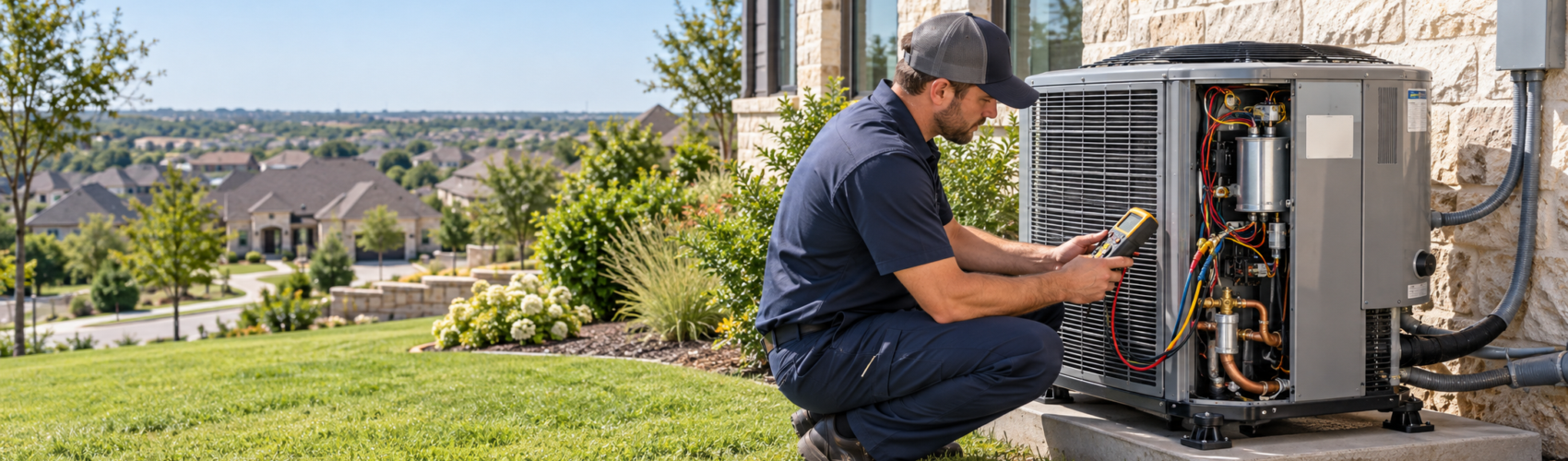
Your home feels wrong. Maybe it is 80 degrees inside in June, or the furnace fan is running in January but nothing warm is coming out. Maybe the thermostat screen is blank, or there is water on the floor by the closet where the air handler lives. You know something needs repair, but your HVAC system is really several systems working together, and any one of them can be the weak link.
In this guide, we will help you figure out which part of your heating and cooling system is most likely causing the problem: the outdoor unit, the indoor unit, the ductwork, the thermostat, or the electrical supply. We will cover simple checks you can do safely, what each symptom usually means, and what happens during a professional HVAC repair visit in Rowlett. Knowing where the problem lives helps you describe it clearly and get the right fix faster.
HVAC Repair Diagnostic Overview
| What You Notice | Most Likely Area | What a Technician Checks |
| Thermostat screen is blank | Thermostat or low-voltage power | Batteries, wiring, transformer, float switch. |
| Indoor fan runs, outdoor unit silent | Outdoor unit electrical | Breaker, disconnect, contactor, capacitor. |
| Outdoor unit runs, warm air inside | Refrigerant or compressor | Pressures, compressor, indoor coil. |
| Weak airflow everywhere | Filter, blower, or frozen coil | Filter, blower motor, coil, static pressure. |
| Some rooms hot, others fine | Ductwork | Disconnected, crushed, or leaky ducts. |
| Water near the indoor unit | Condensate drain | Drain line, pan, float switch, pump. |
| Breaker keeps tripping | Electrical or compressor | Wiring, capacitor, compressor windings. |
| Furnace fan runs, no heat | Ignition or safety controls | Igniter, flame sensor, limit switch, gas valve. |
Key Takeaways
- An HVAC system has several parts: the thermostat, the outdoor unit, the indoor air handler or furnace, the ductwork, and the electrical supply. A problem in any one of them can make the whole system seem broken.
- Where the symptom shows up is a clue. A silent outdoor unit, weak airflow, and a blank thermostat each point to different areas.
- Simple checks like the thermostat settings, air filter, and breakers are safe for homeowners. Refrigerant, electrical, and gas work should be left to licensed professionals.
- Describing exactly what you see and hear helps the technician diagnose faster.
The Five Parts of Your HVAC System
- The thermostat tells the system when to run and in which mode.
- The outdoor unit (condenser or heat pump) contains the compressor, outdoor coil, and fan. It releases heat outdoors in summer, and a heat pump also gathers heat in winter.
- The indoor unit is a furnace or air handler with the blower and indoor coil. In gas homes, the furnace also makes heat.
- The ductwork carries air to and from every room.
- The electrical supply includes breakers, disconnects, and low-voltage control wiring that connect it all.
Is the Problem Your Thermostat?
A blank, frozen, or unresponsive thermostat can make a perfectly good system look dead. Batteries die, settings get changed, and smart thermostats can lose Wi-Fi or update in strange ways. Many systems also use a safety float switch that cuts power to the thermostat when the condensate drain backs up, so a blank screen in summer can actually be a drain problem.
- Make sure the thermostat is set to COOL or HEAT, not OFF.
- Set the temperature at least three degrees past the current room temperature.
- Replace batteries if your thermostat uses them.
- Check that the fan is set to AUTO, not ON.
Is the Problem Your Outdoor Unit?
If the indoor fan is blowing but the air is warm in summer, walk outside and look at the condenser. Is the fan on top spinning? Is the unit humming? If the unit is silent, the problem may be a tripped breaker, a pulled disconnect, a failed contactor, or a weak capacitor. If you hear humming but the fan is not turning, a capacitor or fan motor is a common cause. Do not poke into the unit with sticks or tools. The capacitor holds a dangerous electrical charge even with the power off.
If the outdoor unit runs normally but the air inside stays warm, the issue may be low refrigerant from a leak, a failing compressor, or a dirty or frozen indoor coil. Our AC repair in Rowlett team handles these cooling-side problems.
Is the Problem Your Indoor Unit?
The indoor unit moves the air and, in gas homes, makes the heat. Weak airflow from every vent often points to a clogged filter, a failing blower motor or capacitor, or a coil that has frozen over. In winter, a furnace fan that blows cold air usually means the burners did not light or the furnace shut them off for safety. Our guide to furnace repair in Rowlett explains why a furnace can run without heating.
Is the Problem Your Ductwork?
If the system seems to run normally but certain rooms are always hot or cold, look at the ducts. In many Rowlett homes, ducts run through hot attics where flex duct can sag, crush, or come apart at connections. A disconnected duct can dump cooled air into the attic while a back bedroom gets almost nothing. Duct problems rarely cause a complete shutdown, but they cause plenty of comfort complaints and higher energy bills.
Is the Problem Electrical?
If the HVAC breaker trips repeatedly, do not keep resetting it. Repeated trips can mean a short in the wiring, a failing capacitor, a compressor that is drawing too much current, or a loose connection that is overheating. Reset the breaker once. If it trips again, call for service. Burning smells near the indoor or outdoor unit are also a reason to turn the system off and call right away.
What About Water Leaks?
Air conditioners pull moisture out of the air, and that water drains through a condensate line. When the line clogs with algae and sludge, water backs up into the pan and can overflow onto the floor or through a ceiling if the unit is in the attic. Many systems have a float switch that shuts down cooling to prevent overflow. Clearing the drain line and checking the pan, pump, and switch usually solves the problem.
Safe Checks Before You Call
- Check the thermostat mode, setpoint, and batteries.
- Replace the air filter if it looks gray or clogged.
- Check the breakers for the indoor and outdoor units and reset once if tripped.
- Check the outdoor disconnect box near the condenser to make sure it is in the ON position.
- Look for ice on the refrigerant lines or indoor coil. If you see ice, turn the system off and let it thaw with the fan ON.
- Look for water around the indoor unit or a full drain pan.
If you smell gas, leave the home and call 911 and Atmos Energy at 866-322-8667 from outside. Do not try to troubleshoot a gas furnace when you smell gas.
What Happens During an HVAC Repair Visit?
- Listening to the Symptoms: We ask when it started, what you noticed, and what you already checked.
- Checking Controls and Power: We test the thermostat, low-voltage wiring, breakers, and safety switches.
- Inspecting Outdoor and Indoor Units: We check capacitors, contactors, motors, coils, and the furnace ignition sequence.
- Measuring Performance: We check refrigerant pressures, temperature split, and airflow.
- Explaining the Fix: We tell you what failed, why, and what it will cost before we start.
- Repair and Verify: We complete the repair and run the system through a full cycle.
Repair or Replace?
| Factor | Repair Usually Makes Sense | Replacement Deserves a Look |
| System age | Under about 10–12 years | 15 years or older |
| Type of failure | Capacitor, contactor, motor, sensor | Compressor or heat exchanger failure |
| Repair history | First major repair in years | Repeated repairs every season |
| Energy bills | Steady | Climbing year after year |
If you are leaning toward a new system, our AC replacement in Rowlett page explains the process.
Common HVAC Repairs in Rowlett
- Capacitor and contactor replacements on outdoor units
- Blower motor and fan motor repairs
- Refrigerant leak detection and repair
- Condensate drain line clearing and float switch resets
- Furnace igniter and flame sensor service
- Thermostat replacement and wiring repairs
- Duct reconnection and sealing
Tired of Guessing What Is Wrong With Your HVAC System?
You do not have to figure it out alone. Since 1957, Harlen Johnson HVAC, Plumbing & Electrical has been diagnosing and fixing heating and cooling systems across North Texas. Call 972-241-7771 today, and our licensed technicians will find the real problem, explain your options, and get your home comfortable again. For after-hours cooling failures, our emergency AC service team is ready.
Frequently Asked Questions About HVAC Repair in Rowlett, TX
Why is my AC running but blowing warm air?
Common causes include a tripped outdoor unit, a failed capacitor or contactor, low refrigerant, a dirty or frozen coil, or a failing compressor.
Why is my thermostat blank?
Dead batteries, a tripped breaker, a blown fuse in the indoor unit, or a float switch that shut off power because the drain is clogged can all cause a blank thermostat.
Why are some rooms hotter than others?
Uneven temperatures are usually caused by duct problems, such as leaks, crushed flex duct, or disconnected runs, or by blocked vents and returns.
Why does my HVAC breaker keep tripping?
A failing capacitor, compressor, fan motor, or wiring problem can cause repeated trips. Reset it once, and call for service if it trips again.
Why is there water around my indoor unit?
A clogged condensate drain line is the most common cause. A cracked pan, failed condensate pump, or frozen coil that is thawing can also cause leaks.
Is it safe to fix my HVAC system myself?
Thermostat settings, filters, and breaker checks are safe. Refrigerant, electrical components, and gas controls should be handled by licensed professionals.
How do I know if I should repair or replace my HVAC system?
Consider the system’s age, the cost and type of repair, how often it has needed repairs, and your energy bills. Systems over 15 years old with major failures are often better replaced.